What Is AI Hardware ODM?
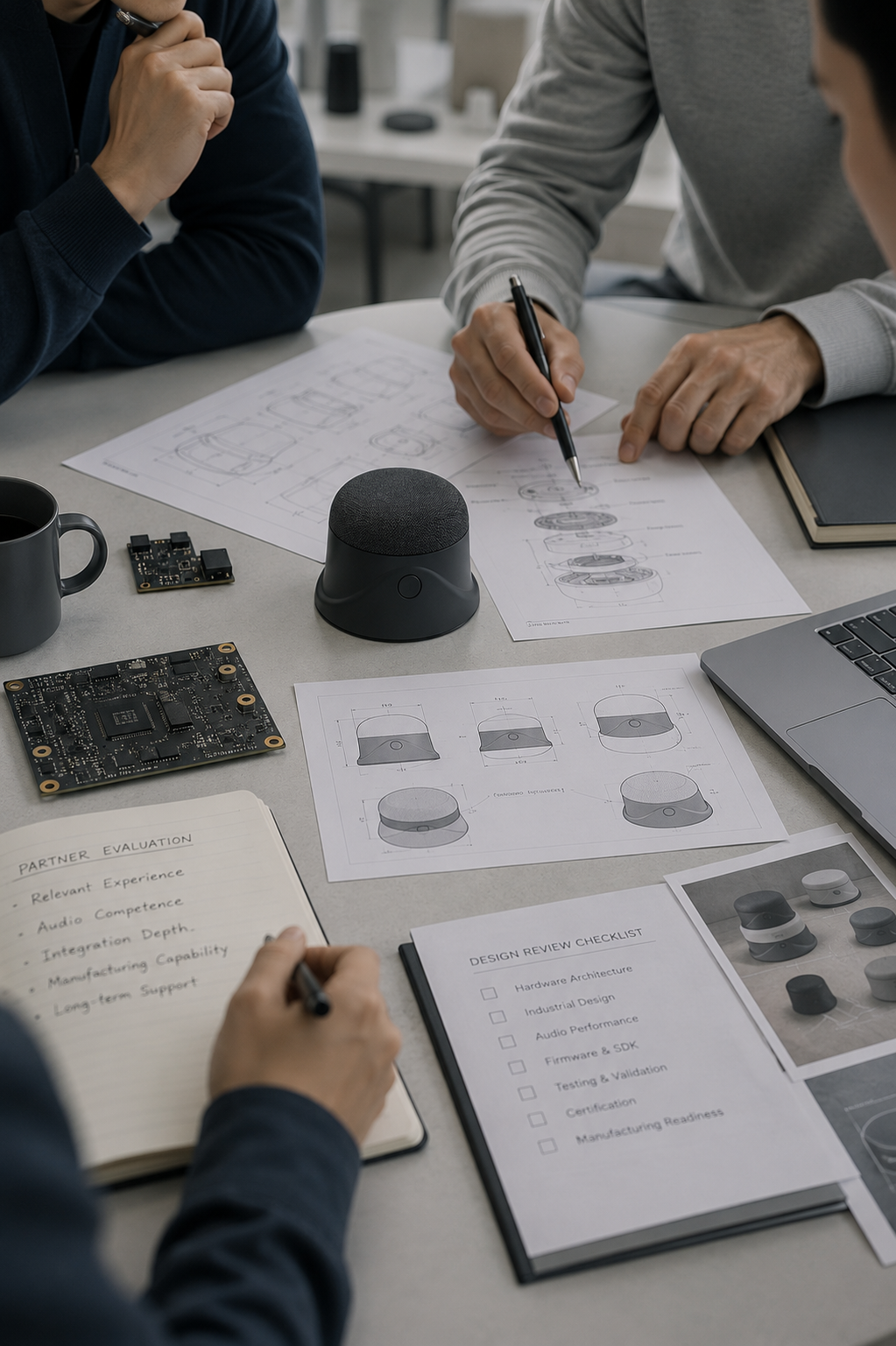
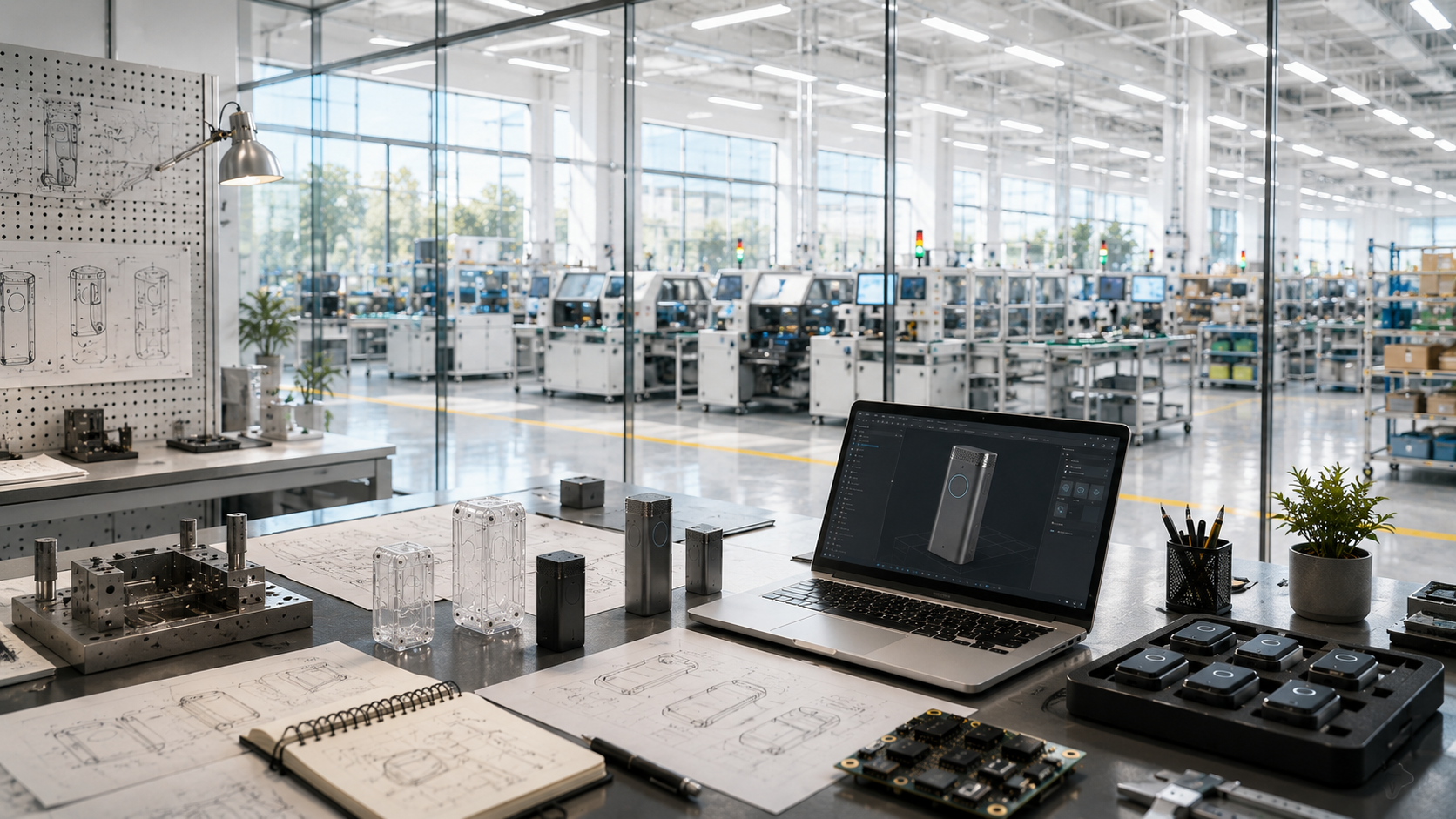
AI hardware ODM — Original Design Manufacturing for AI-powered devices — is the practice of engaging a single partner to design, engineer, and mass-produce a physical product that runs your AI. Rather than assembling an in-house hardware team, sourcing components, and qualifying a factory, you bring a product concept (and often a trained model, SDK, or cloud service) and the ODM delivers a manufacturable device around it. The ODM owns the reference design and the hard engineering; you own the brand, the software, and the customer relationship.
The category exists because building software and building hardware are fundamentally different disciplines. A team that can ship a voice assistant or an edge-AI model in weeks can still spend a year and burn seven figures learning PCB layout, acoustic tuning, battery safety, injection molding, and factory quality control — before shipping a single unit. An AI hardware ODM compresses that curve by contributing the domain expertise that AI teams rarely have on staff: hardware architecture, embedded firmware, mechanical and industrial design, audio DSP, supply-chain sourcing, and regulatory certification.
A full-stack ODM engagement typically spans the entire lifecycle: product definition and architecture, rapid prototyping, the EVT/DVT/PVT validation stages, pilot builds, mass production, and ongoing sustaining engineering. Because one partner carries the design from sketch to shipment, accountability stays in one place and the handoffs that usually delay hardware programs — between design house, firmware vendor, and factory — largely disappear.
GMIC AI is the AI-hardware division of Gainstrong, a contract manufacturer founded in 2009. We have shipped 270+ hardware programs across 15+ years, with client and product teams in California and vertically integrated engineering and manufacturing in Shenzhen — SMT through final assembly under one roof. The rest of this guide walks through each stage of that journey and the decisions that shape cost, timeline, and quality along the way.
ODM vs OEM
ODM and OEM are the two dominant manufacturing models, and the distinction comes down to who owns the design. In an OEM (Original Equipment Manufacturer) relationship, you arrive with a complete design — schematics, mechanical files, a bill of materials — and the manufacturer builds it to your specification. You own the intellectual property and control every detail; the factory contributes production capacity and process expertise but not the design itself.
In an ODM relationship, the manufacturer contributes an existing design or reference platform and adapts it to your needs. The ODM already owns proven hardware, firmware, and tooling, so you inherit years of engineering and skip much of the risk and cost of starting from zero. The tradeoff is that the ODM retains rights to the underlying platform, and heavily customized elements are usually negotiated per program. In practice most AI-device programs are hybrids: an ODM reference platform for the parts that don't differentiate you (power, connectivity, enclosure) combined with OEM-style custom work where your product needs to stand apart.
The right choice depends on how differentiated your hardware must be, how fast you need to ship, and how much upfront engineering budget you can commit. Teams whose value lives in software and AI usually favor ODM because it gets a credible device into customers' hands quickly; teams building a truly novel physical product lean toward OEM or deep-customization ODM. GMIC AI supports the full spectrum — from light customization (rebrand and repackage a shipping platform) to deep customization (custom PCB, enclosure, and firmware).
ODM vs. OEM
| Feature | ODM | OEM |
|---|---|---|
| Design ownership | Manufacturer owns the reference design; you license and adapt it | You own the full design and IP; factory builds to spec |
| Time to market | Fast — 3–6 months by building on a proven platform | Slower — 9–18 months to engineer from scratch |
| Customization | Light to deep: rebrand, repackage, or custom PCB/firmware | Unlimited — every element is yours to define |
| Upfront cost | Lower — NRE shared across the platform's install base | Higher — you fund all engineering and tooling |
| Best for | AI/software teams needing a device fast without a hardware org | Companies whose differentiation lives in novel hardware |
Prototype Development
Prototype development is the bridge between an idea and a device you can actually build at scale. It moves a concept through progressively more production-representative builds — proving first that the product works, then that it can be manufactured reliably, and finally that the factory can produce it consistently at volume. Each stage narrows uncertainty and locks decisions, so problems get caught while they are still cheap to fix rather than after tooling is cut.
The stages below describe a typical path from discovery to mass production. Programs rarely move in a perfectly straight line — teams often loop back after a build reveals an issue — but the sequence and the intent of each phase stay consistent across nearly every hardware product.
Product Discovery
Discovery translates a product vision into concrete engineering requirements. This is where use case, target cost, form factor, battery life, connectivity, and the AI workload are pinned down, and where feasibility tradeoffs surface early. For AI devices, this stage answers the pivotal architecture question: what runs on-device at the edge versus in the cloud, and what compute, memory, and power that implies. A clear requirements document written here prevents scope creep and expensive rework later.
Industrial Design
Industrial design shapes how the product looks, feels, and is held or worn. Designers develop the form, ergonomics, materials, and finish, balancing aesthetics against manufacturability and the internal volume the electronics demand. For wearables and voice devices, industrial design also governs where microphones, speakers, buttons, and LEDs sit — decisions that directly affect acoustic performance and usability, not just appearance.
PCB & PCBA Design
The printed circuit board is the electronic heart of the device. Engineers select the processor or SoC, memory, wireless modules, sensors, and power components, then lay out a board that fits the enclosure while meeting signal-integrity, thermal, and EMI requirements. The PCBA (the assembled board with components populated) is what gets fabricated and tested. Good layout discipline here — controlled impedance, clean power delivery, sensible test points — pays off through every later stage of validation and production.
Firmware Development
Firmware is the embedded software that makes the hardware behave like a product: it boots the device, manages power, drives the radios, reads sensors, and connects to your SDK or cloud. Early firmware runs on the first prototype boards to prove the electronics, then matures in lockstep with the hardware through validation. For AI devices, firmware also handles capture pipelines, buffering, and secure data handling — the plumbing that gets audio or sensor data to your model reliably.
Mechanical Design & Rapid Prototyping
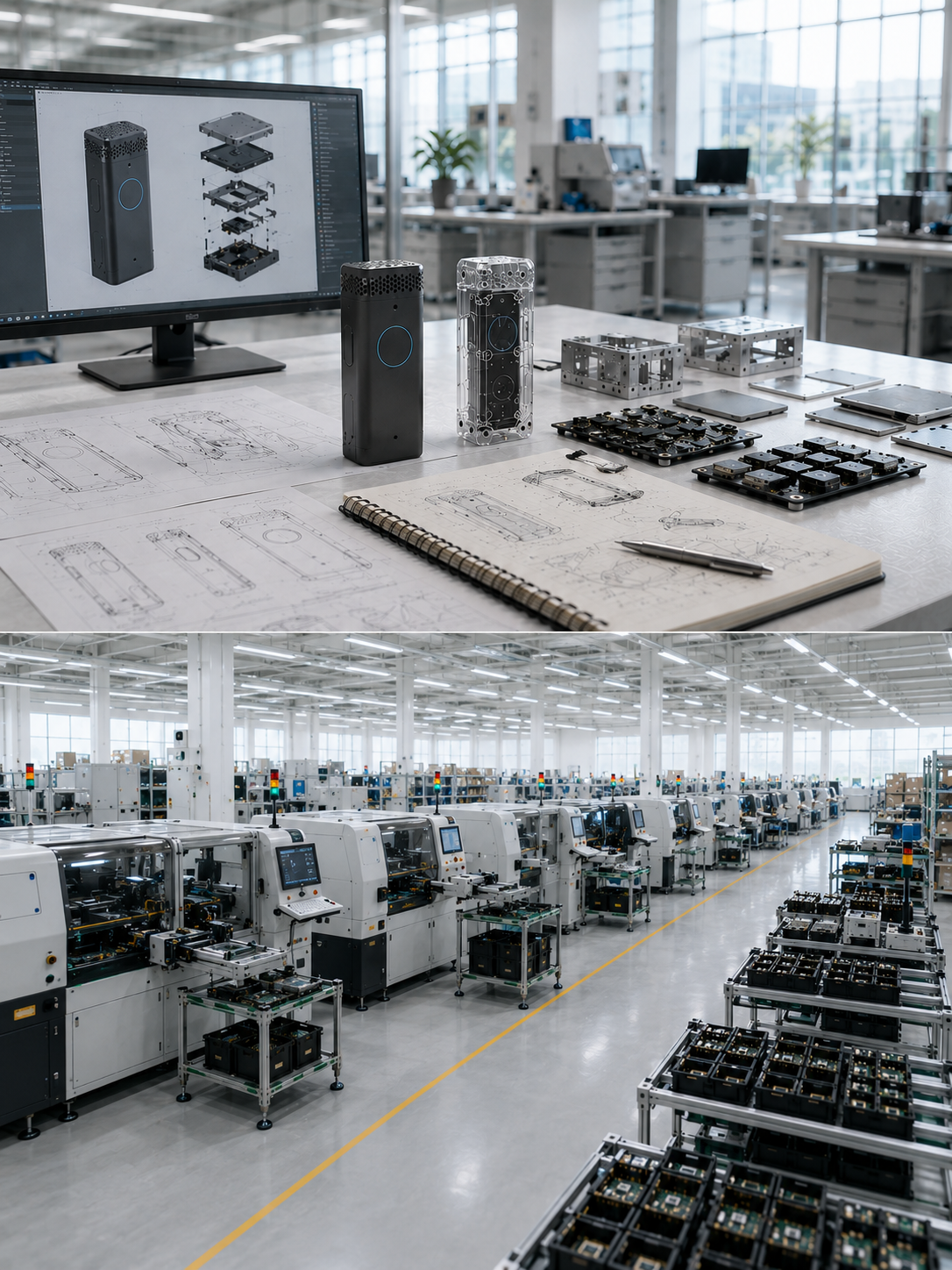
Mechanical design turns the industrial-design intent into engineered parts — enclosures, brackets, seals, and internal structure — modeled in CAD for real-world assembly. Rapid prototyping with 3D printing and CNC produces physical parts in days so the team can check fit, feel, and assembly before committing to tooling. Iterating in prototype materials is inexpensive; changing a steel injection-molding tool after it is cut is not, which is why several rapid cycles here save real money.
EVT / DVT / PVT
EVT, DVT, and PVT are the three formal validation gates every serious hardware program passes through. EVT (Engineering Validation Test) proves the design works — that the electronics, firmware, and mechanics function together. DVT (Design Validation Test) proves the design is production-ready and meets every specification and certification requirement. PVT (Production Validation Test) proves the factory can build it at volume with consistent quality using production tooling and processes. The comparison table below breaks down each phase in detail.
Pilot Production to Mass Production
After PVT, the program ramps from a small pilot run — often a few hundred to a few thousand units — into full mass production. The pilot validates the assembly line, test fixtures, yield, and packaging at real (if modest) scale before capital and inventory commitments grow. Once yield and quality are stable, volume scales up. GMIC AI's Shenzhen operation is vertically integrated from SMT through final assembly and scales to 50,000+ units per month, so the transition from pilot to volume happens under one roof rather than across handoffs between vendors.
Prototype vs. Production
| Phase | Typical Activities | Timeline | Cost Drivers |
|---|---|---|---|
| Prototype | Proof-of-concept boards, breadboards, 3D-printed housings; prove the core idea | 2–6 weeks | Engineering hours, quick-turn PCBs, printed parts |
| EVT | First integrated units; verify electronics, firmware, and mechanics work together | 4–8 weeks | Design iteration, small board runs, component samples |
| DVT | Production-intent design; run certification pre-testing and reliability testing | 6–10 weeks | Soft tooling, certification labs, test fixtures |
| PVT | Build on production tooling and line; confirm yield, quality, and process | 4–8 weeks | Hard tooling, line setup, pilot-run materials |
| Mass Production | Full-volume manufacturing, QC, packaging, and fulfillment | Ongoing | Component volume pricing, labor, logistics, yield |
Firmware Development
Firmware is the embedded software that lives on the device and turns a circuit board into a product. It runs on the microcontroller or SoC below the level of any app or cloud service, orchestrating boot, power, radios, sensors, and the data pipeline that feeds your AI. For AI hardware in particular, firmware quality is often the difference between a demo and a shippable product: it governs battery life, connection reliability, and how cleanly data reaches your model.
Embedded Firmware & MCU Programming
Embedded firmware is written close to the metal, usually in C or C++ on an RTOS or bare-metal environment, and is tightly constrained by the memory, compute, and power budget of the chosen MCU or SoC. Engineers implement device drivers, the main application loop, sensor sampling, and the real-time behavior the product depends on. Disciplined, well-structured firmware is what lets a device stay responsive and stable in the field for years.
Bluetooth & Wi-Fi Connectivity
Most AI devices rely on wireless links to phones, gateways, or the cloud. Bluetooth Low Energy is common for pairing, control, and low-bandwidth data, while Wi-Fi handles higher-throughput uploads such as audio or firmware images. Robust connectivity firmware manages pairing, reconnection, roaming, and graceful degradation when the network drops — the unglamorous logic that determines whether users trust the device.
OTA Updates
Over-the-air update capability lets you ship fixes and features to devices already in customers' hands. A well-designed OTA system delivers updates in the background, verifies image integrity and authenticity before installing, and can roll back safely if an update fails — so a bad build never bricks a fleet. For AI products that evolve quickly, dependable OTA is essential to keeping deployed hardware current with your software roadmap.
Power Management
Battery life is one of the most scrutinized specs on any portable AI device, and it is won or lost in firmware. Engineers use sleep states, duty cycling, dynamic clock and voltage scaling, and careful control of radios and sensors to stretch every milliamp-hour. On voice and wearable products, balancing always-listening responsiveness against battery drain is a defining design challenge that firmware must solve.
SDK Integration & Cloud Connectivity
This is where the device meets your platform. Firmware integrates your SDK or APIs so captured data flows to your model or backend and results flow back to the device. Clean integration handles authentication, retries, buffering during connectivity gaps, and efficient payload formatting — abstracting hardware complexity so your software team can work against a stable, predictable interface.
Security
AI devices frequently capture sensitive data — voice, video, health, or location — which makes security a first-class requirement, not an afterthought. Strong practices include secure boot, encrypted storage and transport, signed firmware, hardware-backed key storage, and unique per-device credentials. Building these in from the start protects users, safeguards your brand, and eases certification and enterprise-security reviews later.
Firmware Responsibilities
| Area | What It Covers | Why It Matters |
|---|---|---|
| Connectivity | BLE/Wi-Fi stacks, pairing, reconnection, data transport | Determines whether the device stays reliably linked to phone and cloud |
| OTA Updates | Signed, verified background updates with safe rollback | Lets you fix bugs and ship features to deployed fleets remotely |
| Power Management | Sleep states, duty cycling, radio and sensor control | Directly sets battery life — the spec users judge most harshly |
| Security | Secure boot, encryption, signed firmware, per-device keys | Protects sensitive captured data and clears enterprise reviews |
Ship the OTA update pipeline before your first production run, not after. Devices in the field will always need fixes, and a fleet with no reliable way to update is a fleet you cannot recover — retrofitting OTA later is far harder than designing it in from day one.
Audio DSP
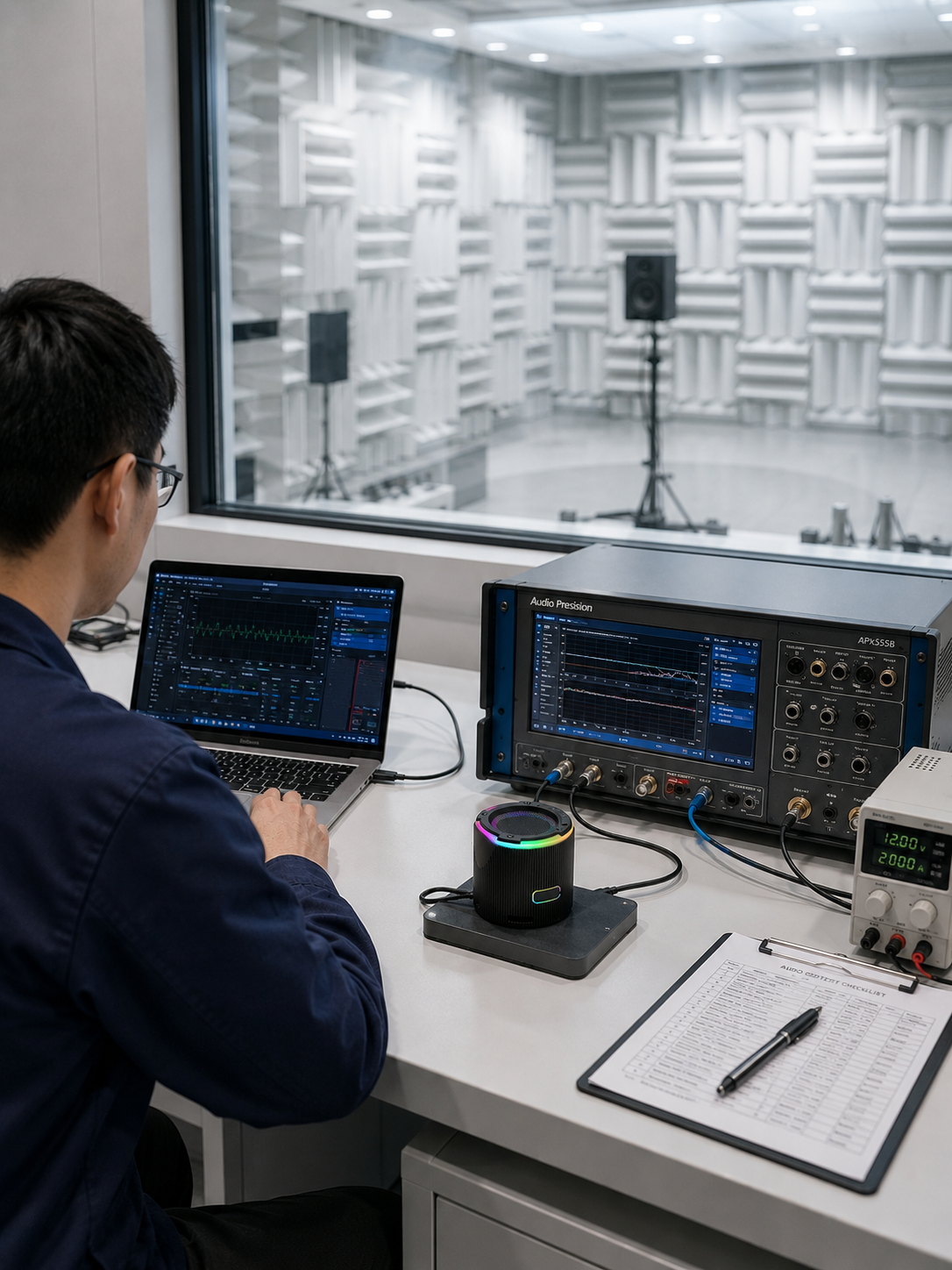
For voice-first AI devices, audio digital signal processing is where products succeed or fail. A speech model can only be as good as the audio it receives, and real environments are hostile: background noise, echo, distance, overlapping speakers, and reverberation all degrade raw microphone signals. Audio DSP is the layer that cleans and conditions sound before it reaches your model or the cloud — and it is one of the hardest capabilities for a software team to build without dedicated acoustic engineering.
Beamforming & Microphone Arrays
A single microphone captures everything around it equally; an array of microphones lets DSP electronically "steer" sensitivity toward the person speaking and away from noise sources. Beamforming combines the signals from multiple mics — using their physical spacing and timing differences — to boost the target voice and suppress the rest. Array geometry, mic placement in the enclosure, and beamforming tuning together determine how far and how clearly a device can hear.
Echo Cancellation & Noise Suppression
Acoustic echo cancellation (AEC) removes the device's own speaker output from the microphone signal, which is essential for any product that plays audio while listening — a prerequisite for natural, barge-in voice interaction. Noise suppression separates speech from steady and transient background sounds such as HVAC, traffic, or machinery. Tuned well, these algorithms deliver clean speech to your model even in demanding, real-world settings.
Voice Activity Detection & Speaker Diarization
Voice activity detection (VAD) identifies when someone is actually speaking, so the device can save power, trigger capture, and avoid sending silence or noise to the cloud. Speaker diarization goes further, distinguishing who spoke when — critical for meeting notes, clinical documentation, or any multi-party conversation. Running lightweight VAD on-device is also a key privacy and battery-life win, since it gates the far heavier processing downstream.
Audio DSP for Healthcare & Voice AI
In healthcare, audio quality has direct clinical consequences: a misheard medication or dosage in an ambient documentation device is a patient-safety issue, not just a UX flaw. These environments are acoustically difficult — busy wards, exam rooms, multiple speakers — so DSP must reliably isolate the intended speaker and preserve intelligibility. Tuning for the specific acoustics of the deployment, and for the vocabulary the model must transcribe accurately, materially improves downstream accuracy.
Audio DSP for Field Service & Enterprise
Field service and industrial settings add wind, machinery, vehicles, and distance to the mix, often with the device worn on the body or clipped to clothing. Enterprise deployments demand consistent capture across offices, warehouses, and conference rooms. In both cases, robust noise suppression and beamforming tuned to the real operating environment keep transcription and voice commands dependable where consumer-grade audio would break down.
Tune your audio DSP with recordings from the real deployment environment, not a quiet lab. A device that sounds flawless on the bench can fall apart on a hospital ward or a factory floor — capture representative noise early and validate against it.
Manufacturing
Manufacturing is where a validated design becomes thousands of identical, reliable products. It is a discipline in its own right — distinct from design — and it is where many first-time hardware programs stumble, because a design that works as a handful of prototypes may not build consistently at volume. Volume manufacturing is about repeatability: producing unit ten thousand to the same quality as unit one, at a cost that supports your business model.
Supply Chain & Component Sourcing
Every device is only as available as its scarcest component. Sourcing covers selecting suppliers, negotiating pricing, managing lead times, and building resilience against shortages and end-of-life parts. Experienced ODMs design with sourcing in mind — favoring components with multiple qualified suppliers and healthy availability — so a single allocation or discontinuation cannot stall your production. Established factory relationships and buying leverage also directly lower your per-unit cost.
DFM & DFA
Design for Manufacturing (DFM) and Design for Assembly (DFA) adapt a design so it can be built efficiently, reliably, and at low cost. A DFM/DFA review catches problems that only appear in production — components too close to place accurately, parts that can be assembled backwards, features that drive scrap — before tooling is committed. Running these reviews during design, rather than discovering the issues on the line, is one of the highest-leverage steps in the entire program.
SMT & Assembly
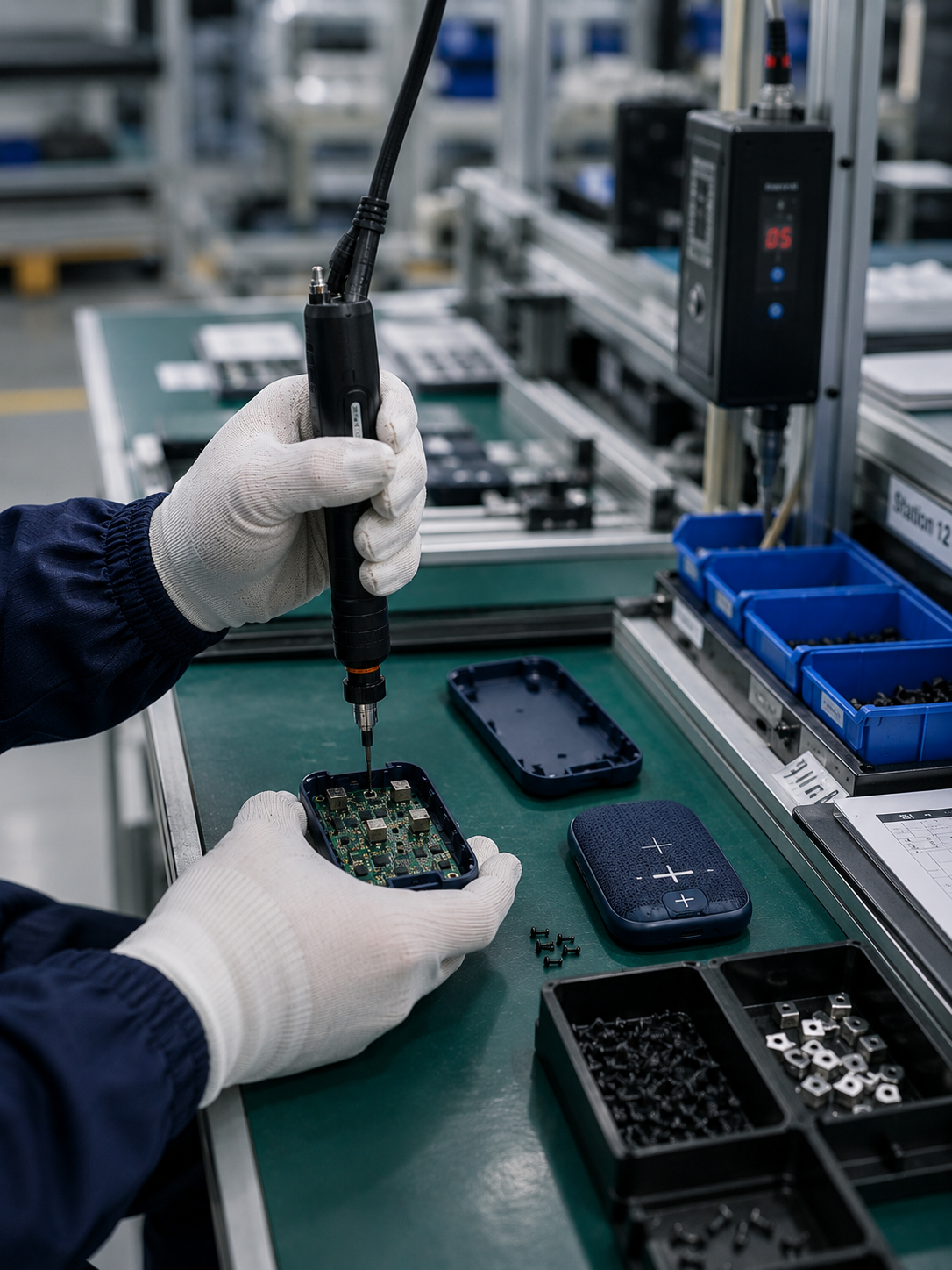
Surface-mount technology (SMT) is the automated process that places and solders components onto circuit boards — the foundation of modern electronics manufacturing. After SMT, boards are combined with enclosures, batteries, displays, and other parts through a mix of automated and manual assembly. GMIC AI's Shenzhen operation is vertically integrated from SMT through final assembly, so board fabrication, population, and device build happen under one roof rather than across separate vendors and handoffs.
Testing & Quality Control
Quality control ensures every unit meets spec before it ships. Functional test verifies each device powers on, connects, and performs correctly; additional checks cover audio, RF, calibration, and cosmetics. Statistical process control, reliability testing, and clear yield targets keep quality consistent as volume scales. Well-designed test fixtures and pass/fail criteria — defined during DVT — are what make high-volume QC both fast and trustworthy.
Mass Production & Packaging
At full volume, the focus is throughput, yield, and cost control while holding quality steady. Packaging is part of the product experience and part of the logistics equation — it must protect the device in transit, present the brand, and satisfy retail or regulatory requirements. GMIC AI scales to 50,000+ units per month, with packaging designed alongside the product rather than bolted on at the end.
White-Label Manufacturing
White-label (or private-label) manufacturing lets you bring a device to market under your own brand built on a proven platform. Instead of engineering from scratch, you customize an existing design — branding, enclosure, firmware, and packaging — to the depth your product needs. It is the fastest, lowest-risk path to a shippable AI device, and it pairs naturally with the light-to-deep customization spectrum an ODM offers.
Manufacturing Stages
| Stage | Description | Key Deliverables |
|---|---|---|
| Sourcing | Qualify suppliers, lock pricing and lead times, secure component availability | Approved vendor list, released BOM, purchasing plan |
| SMT & Assembly | Populate and solder boards, then integrate enclosure, battery, and parts | Assembled PCBAs and fully built devices |
| Testing & QC | Functional, RF, audio, and cosmetic testing with defined pass/fail criteria | Test reports, yield data, quality records |
| Packaging | Protective and branded packaging, labeling, and fulfillment prep | Retail-ready, shippable finished goods |
Run a small pilot build before committing to full volume. A few hundred units on production tooling will expose assembly, yield, and test issues while they are still cheap to fix — long before you have tens of thousands of units and inventory on the line.
Certifications
Certification is the gate between a finished design and a product you are legally allowed to sell. Any device with a radio, a battery, or a power supply must meet the regulatory requirements of every market it ships into, and non-compliance can mean seized shipments, forced recalls, or fines. Certification is not a single step but a set of parallel tracks — radio, safety, environmental, and sometimes medical — each with its own testing, documentation, and timeline.
FCC & CE
FCC certification is mandatory for electronic devices sold in the United States, covering electromagnetic emissions and, for anything with a radio, intentional-radiator testing. CE marking is the equivalent gateway for the European Economic Area, spanning the EMC, radio (RED), and safety directives. Both require testing at accredited labs, and both are far cheaper to pass when their requirements are designed in from the start rather than chased after a failed scan.
RoHS & REACH
RoHS restricts hazardous substances such as lead and certain flame retardants in electronics, and is required for the EU and increasingly expected elsewhere. REACH governs the broader use of chemical substances in products sold in Europe. Compliance is driven largely by component and material selection, so it is managed through the bill of materials and supplier declarations rather than end-of-line testing.
UL & Battery Certifications
Safety certifications like UL address fire and electrical-shock risk and are often required by retailers, distributors, and enterprise buyers even where not strictly mandated. Battery-powered devices carry their own critical requirements: UN 38.3 for lithium-battery transport safety is effectively mandatory to ship product by air or sea, alongside IEC 62133 for cell and battery safety. Because rechargeable lithium cells are a genuine safety and logistics hazard, these certifications are non-negotiable for any portable AI device.
Bluetooth SIG & Wi-Fi Alliance
Devices using Bluetooth must be qualified through the Bluetooth SIG to use the trademark and ensure interoperability; skipping it exposes you to legal and compatibility problems. Wi-Fi Alliance certification similarly validates interoperability and lets you carry the Wi-Fi CERTIFIED logo. These industry certifications sit alongside the government radio approvals (FCC/CE) rather than replacing them.
Medical Certifications
Devices making medical claims or used in clinical care face a much higher bar. In the US that can mean FDA clearance; in Europe, compliance with the Medical Device Regulation (MDR). Standards such as IEC 60601 govern the safety of medical electrical equipment. These pathways are lengthy and documentation-heavy, so any product heading toward a regulated medical use should scope its certification strategy at the very beginning of the program.
Certification Comparison
| Certification | Region | Applies To | Typical Timeline |
|---|---|---|---|
| FCC | United States | Emissions and radio for electronic/wireless devices | 3–6 weeks |
| CE | European Economic Area | EMC, radio (RED), and safety directives | 4–8 weeks |
| RoHS | EU (widely adopted) | Hazardous-substance limits, verified via BOM | 1–3 weeks |
| UL | US / North America | Electrical and fire safety; often retailer-required | 6–12 weeks |
Plan certifications from day one. Building the requirements into the design phase — and running pre-scans during DVT — avoids the costly redesigns and schedule slips that come from discovering a compliance failure after tooling is cut.
Why Choose an AI Hardware ODM Partner?
The alternative to an ODM is building an in-house hardware team — hiring across a dozen specialties, sourcing components, and qualifying a factory — before you ship a single unit. For most AI and software companies that is slower, riskier, and far more expensive than partnering with a team that already has the people, tooling, and factory relationships in place. When evaluating an AI hardware ODM partner, look for depth across the full stack:
- Engineering capability — in-house hardware architecture, PCB design, and mechanical/industrial design, not just assembly.
- Embedded systems & firmware — proven ability to deliver reliable firmware, connectivity, power management, and OTA updates.
- Acoustics & audio DSP — mic arrays, beamforming, echo cancellation, and noise suppression tuned for real environments.
- Supply chain & manufacturing — established supplier relationships and buying leverage that secure availability and lower unit cost.
- Certification experience — a track record navigating FCC, CE, UN 38.3, and other approvals without schedule surprises.
- Mass production capability — the capacity to scale from pilot to tens of thousands of units per month with stable quality.
- Long-term support — sustaining engineering, component-lifecycle management, and revisions that keep the product shippable for years.
Why GMIC AI
GMIC AI exists to close a specific gap: AI teams build software fast but struggle to build hardware. As the AI-hardware division of Gainstrong — a contract manufacturer founded in 2009 — we bring 15+ years of manufacturing experience and 270+ shipped hardware programs to teams whose expertise is in models and software, not injection molding and SMT lines. The result is a partner that speaks both languages and carries a product from concept to 50,000+ units per month.
Our structure is built for exactly this work. Client and product teams in California stay close to your roadmap and time zone, while vertically integrated engineering and manufacturing in Shenzhen run everything from SMT through final assembly under one roof. That means no handoffs between a separate design house, firmware vendor, and factory — the same organization that designs your device also builds it, so accountability and quality stay in one place.
We offer full-stack OEM/ODM services — hardware architecture, PCB, embedded firmware, mechanical and industrial design, audio tuning, SDK/API integration, prototype and validation, private label and packaging, and certification support — and we scale the engagement to fit. That ranges from light customization, where we rebrand and repackage an existing platform to get you to market quickly, to deep customization with a custom PCB, enclosure, and firmware. Across AI voice recorders, wearables, communication devices, speakers, and smart badges, our aim is the same: turn your AI into a device your customers can hold.